Afghanistan in Global Rankings: Why Shouldn’t We be Last?
- Latest content, Masir
- 2026/03/07
In general, security means being safe from any kind of physical or psychological harm, threat, or disturbance. But are Afghan citizens truly living in complete safety right now?

Ramzia Niazi
———————————-
According to the most recent assessment by Georgetown University, among 181 countries evaluated in the Women, Peace, and Security Index, Afghanistan ranks at the bottom, showing the worst performance regarding women.
This ranking comes at a time when Afghanistan is living under Taliban rule and control.
The present article focuses on this very issue: the indicators of security and the situation of women.
The issues of women and security have always been vital and decisive in any society. But today in Afghanistan, they are viewed from two completely different perspectives, which we will discuss further.
First: Security
The key question is: Have the Taliban actually brought security to Afghanistan?
In general, security means being safe from any kind of physical or psychological harm, threat, or disturbance. But are Afghan citizens truly living in complete safety right now?
Some people in the country believe the Taliban have brought security — because they hold power and can identify, arrest, and punish criminals by force.
In their view, the Taliban can cut off a thief’s hand to reform others, carry out qisas (retaliation) against murderers, punish, imprison, and torture women for not wearing proper hijab or for going out without a mahram (male guardian), and overall create fear and terror so that no one dares to commit a crime.
These citizens see the Taliban’s actions as just, legal, and in line with religious and traditional rules — without analyzing the harm they cause.
On the other hand, there are people who are deeply dissatisfied with this situation and consider the Taliban’s behavior a crime against humanity.
When we look closely, we realize there is also something called psychological security — and it simply does not exist in Afghanistan today. In an environment ruled by fear and intimidation, everyone — even those who share Taliban thinking — lives in constant worry that the smallest mistake could lead to arrest and punishment by the Taliban.
In recent years, large numbers of Afghan citizens have been arrested by the Taliban for various reasons and excuses, and have faced physical and mental torture.
In such conditions, psychological insecurity grows even stronger and can make eating and sleeping nearly impossible for many people.
That is why many believe that the Taliban mindset, their dress code, power hunger, use of force, strange laws, and fatwas are actually causing greater insecurity among citizens rather than providing security.
Next: The situation of women
Just like security, there are two opposing views about women.
The first view — common in Afghanistan’s male-dominated society — sees women mostly as property. Many men believe a woman’s place is in the home, and her main responsibilities are housekeeping and bearing children.
They think if a woman leaves the house, it brings corruption to society, brings disaster to the family, and shows a lack of honor (be-ghairati).
Interestingly, some women share this same belief. They see housekeeping and child-rearing as their duty and try to make sure — God forbid — men do not fall into sin because of them.
In reality, this shared mindset between these citizens and the Taliban comes from deeply rooted traditional beliefs in society.
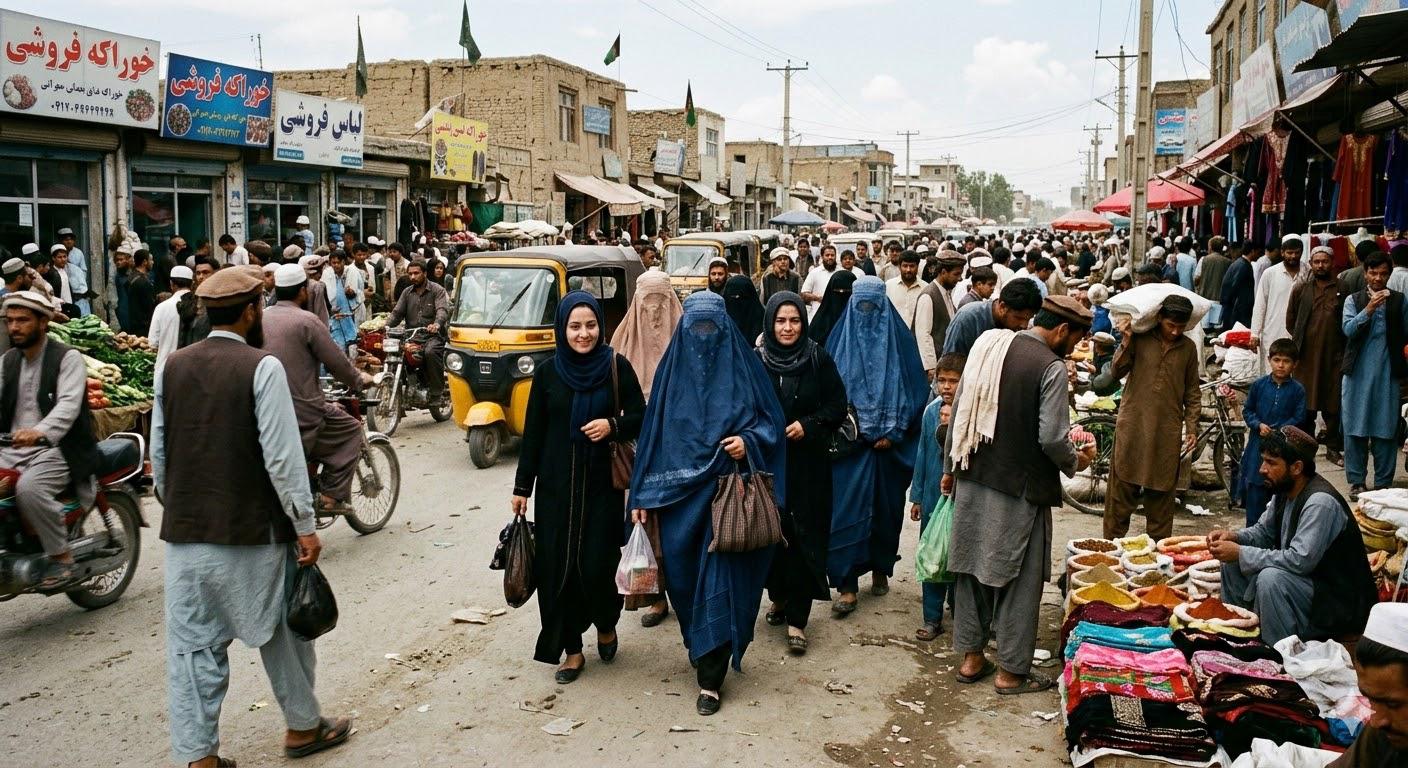
On the other side are women — especially working women and those who value freedom — who had a visible presence in streets and society before the Taliban came.
Most of these women are now confined to their homes. Even if they decide to go out, they are filled with all kinds of fear and terror: fear that the Taliban will demand a mahram, fear of punishment for “bad hijabi”, fear of being taken to prison, and dozens of other fears.
Before the Taliban took power, these women had been active in society for a long time — they worked, walked the city without fear, and became aware of their rights.
Now they cannot tolerate the control and force of men at home, nor can they breathe freely outside because of fear of the Taliban.
As a result, these women suffer deep psychological insecurity, and simply living has become unbearable for them.
Before the Taliban period, many Afghan women enjoyed relative freedom. They could raise their voices against family or social mistreatment. There was even a Ministry of Women’s Affairs (regardless of how well it functioned) that dealt with women’s issues.
Back then, men gradually stopped feeling entitled to lock women inside the house. But now, with the Taliban’s strict rules as an excuse, men once again feel empowered to impose severe restrictions on the women in their families.
Of course, it should also be said that even today there are men in families who support women and are unhappy with how the Taliban treat them.
From all this, we see that the discussion of security and the situation of women in Afghanistan has two sides.
Some believe the Taliban brought security and improved women’s situation.
Others are convinced that the Taliban themselves have created psychological insecurity and are making women’s lives weaker and more unstable day by day.
So, in such circumstances, if Afghanistan ends up at the very bottom of every global ranking, it is neither impossible nor surprising.